How Could The Women Go To
The Tomb on the Sabbath?
Based on The Scroll of Biblical Chronology And Prophecy:
Mapping The Times And Seasons of The Holy Scriptures.
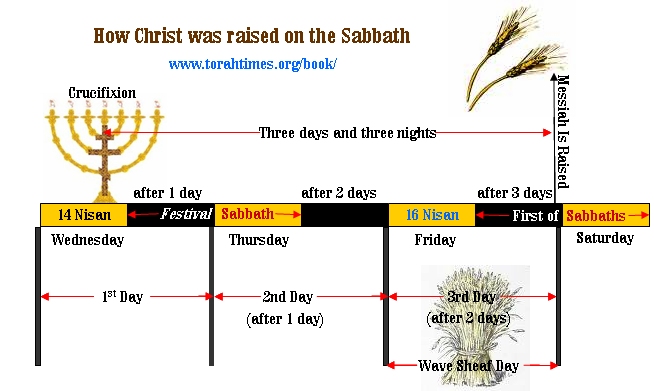
Often we are asked how the women could go to the tomb on the Sabbath day? Were they breaking the Sabbath? Was it permitted? First, we need to clear up a misunderstanding. The women "bought" and "prepared" the spices on Friday between the annual Festival Sabbath and the weekly Saturday Sabbath. So other than take the spices to the tomb, they did little actual work. The chart illustrates this chronology:
The women bought the spices on Friday, Nisan 16. Mark 16:1 says that it was after the Sabbath, i.e. the annual Sabbath that they bought the spices. Then in Mark 16:2 the women go to the tomb on "the first of the Sabbaths". It was called the first Sabbath because after Passover the weekly Sabbaths were counted. This is in Leviticus 23:15.
According to the precept alluded to in Luke 23:56, the women rested on the annual Passover Sabbath. This commandment may be found in Lev. 23:7. However, no mention of a commandment is made for the weekly Sabbath. The gospels wanted to mention where they did keep the commandment, but they pass over any mention of the fourth commandment when the women went to the tomb on the Sabbath. This is probably because what the women did was irregular.
Often human behavior does not follow a strict interpretation of the Law. The Scriptures have plenty of examples of this. Or often people do not follow they law in the way we think it is proper for them to do so. Scripture abounds in examples of this also. We all have a little bit of "Pharisee" in us. Yeshua commanded a man he had healed to pick up his bed on the Sabbath. Yeshua taught people that he wanted mercy and not sacrifice. We should pause before being too hard on them for a minor violation of the Sabbath. They were, after all, not out chopping firewood or earning a living at 5 a.m. in the morning on the Sabbath.
There are other reasons for the women's third day visit. First off the women were more believing than the other disciples in the midst of tragedy. Something impelled them to blindly go, overlooking any traditional inhibitions. They did not go on the annual Sabbath because they had just buried Yeshua and it was a Sabbath. Maybe they went on Friday, but we are not told, and if they had, they would have found the tomb guarded. They would have had to seek another opportunity. In fact, their question "Who shall roll away the stone?" suggests that it was the Sabbath. On any other day the could have asked someone for help and expected it.
On principle, though, chronology should not be built on the basis of typological arguments from theology or assumed human behaviors in a given situation. Chronology should depend only on clear chronological statements in the Scriptures. And we have four gospels that tell us the resurrection was on the "first of the Sabbaths" (Matthew 28:1; Mark 16:2; Luke 24:1; John 20:1, 19).
For Christians who do not believe the Sabbath is valid for this age, the answer to this objection is simple. They believe a new dispensation of non-law began at the cross. Therefore, they should have no objection to the women going to the tomb on the Sabbath.
For more information, you can read the non-technical summary of the Passion chronology in the Sabbath Resurrection article.