Bishop Lightfoot's
Hebrew and Greek Mistakes
Daniel Gregg
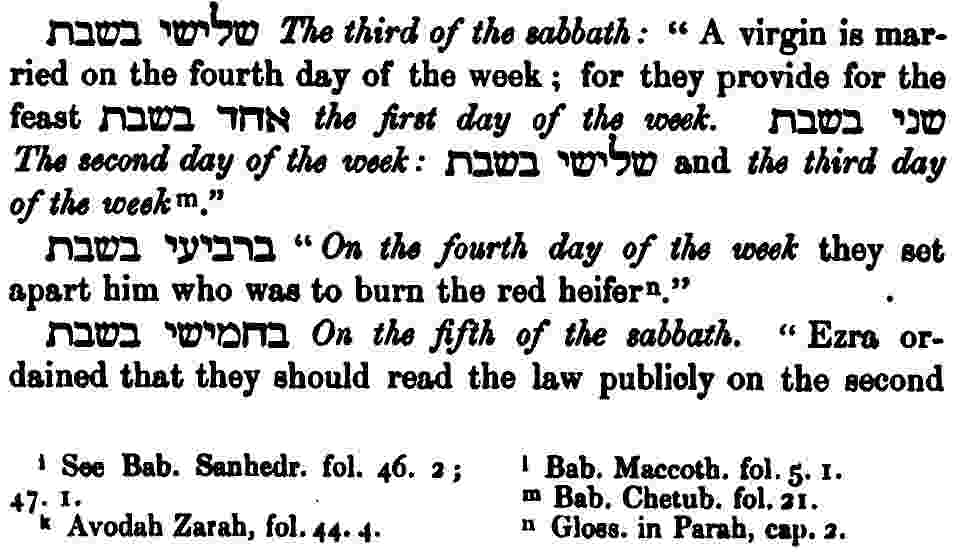
Bishop Lightfoot makes some remarkably trivial mistakes in his alleged matches between Hebrew and Greek phrases in his commentary on Matthew. In Matthew 28:1 he has:
It would be better to quote the whole phrase: τη επιφωσκουση εις μιαν σαββατων = at-the dawning for [the] first of-sabbaths. It will be seen at once that the word εις cannot have the signification "toward" here, but rather its usage is more abstract because it is already on the "first of the sabbaths" "at the dawning" and we are not approaching the day as "toward" might imply. In this sense εν could have been used also. The idea of either εν or εις corresponds to the equivalent abstract usage of the Hebrew ל or ב. The abstract usage is "in connection with" or "in connection to", i.e. "for". This is a rather minor point. For Lightfoot's next word "the", it is not uncommon that a prepositional phrase in Greek is definite, so there should be no real objections to this (cf. Wallace).
And also the Greek word μια is equivalent to the Hebrew word אחת. Lightfoot correctly translates this word "first", but by doing so he has committed himself to a Semiticism. This is also correct, yet he goes back on it by interpolating the word "day" into the text right after "first". One must either take the phrase as fully Greek without recourse to Hebrew, or as a full Semiticism with all its implications. It is less parsimonious to try to squeeze both Semiticism and plain Greek out of the text.
Wherefore, the plain Greek is translated "one [day] of the sabbaths", in which case the grammar implies the additional word "day" ημεραν. Plainly ημεραν σαββατων by itself just means "day of sabbaths" or "Sabbaths Day". The cardinal adjective μιαν simply turns it into "one Sabbaths Day" or "One day of the sabbaths". Thus, if one wants to justify the addition of "day", then one must commit to the cardinal "one" and stay away from the Semitic argument in which cases the Hebrew forms of all the words should be considered.
However, the phrase makes better sense as a Hebraism. This Hebraism, Lightfoot claims is the Talmudic phrase אחד בשבא. But this does not actually correspond to either the Greek in Matthew nor to Lightfoot's alleged translation of it. First the Talmudic phrase literally means "one in seven". The word שבא is really Aramaic[1], and it does not obviously mean "Sabbath". What has happened here is that the Aramaic has transmuted the final ayin ע in שבע for alef: א. This can easily happen in writing since both letters are silent. The lack of tav ת clearly points to the meaning of "seven" however, and not Sabbath. So the phrase in the Talmud merely means "one" or "first" "in seven". This is further proved by the return of the ת in phrases for "Eve of Sabbath" and "Sabbath". Lightfoot's example thus lacks correspondence in respect to the word "Sabbath". It also lacks correspondence in regard to the preposition ב. For the Greek is a genitive and not a dative. Neither does it involve the Greek word εν. Further, Lightfoot's alleged correspondence fails to explain the plural σαββατων. For שבא is not plural. Finally, Lightfoot's example entirely fails to explain the feminine gender of μια. For אחד is not feminine.
The real reason for the mess made by Lightfoot is that he assumed that the Hebrew phrase he found in the Talmud actually meant the same thing as the Greek phrase in Matthew. But it doesn't. A correct reverse translation of the Greek into Hebrew would be: אחת השבתות, which means "first of the Sabbaths", and the feminine gender of אחת directly modifies the feminine gender of שבתות .שבתות is also correctly plural just like the Greek. This is exactly how "first of the sabbaths" would be expressed in Hebrew according to Lev. 23:15, where "seven sabbaths" were counted after the Passover. Furthermore, the Hebrew ה correctly expresses the Greek definite article after the construct case of אחת. Just because Lightfoot can point out similarities in the Talmudic phrase to the Greek phrase does not show equivalency of meaning. In the science of genetics this would be like finding that the DNA of the monkey was 98% the same as that in the human and then jumping to the conclusion that one came from the other based on the evolutionary assumption. Well Lightfoot has an equally invalid assumption. He has to assume based on his tradition that the resurrection was on the first day of the week that the NT usage must equal the Talmudic usage. However, the linguistic evidence does not warrant the assumption.
Lightfoot's tradition leads him to start with "first day of the week" and to assume that "sabbath" = "week". Otherwise "first day of the sabbath" makes no sense with his tradition of a Sunday resurrection. The Greek "one of the sabbaths" does not correspond, and neither does Talmud, "one in seven". This leaves Lightfoot high and dry with only his assumption to support him.
We now move on to Lightfoot's next set of arguments:
The first thing to notice is that we now really have the word Shabbat in the Talmudic source. Other than this, all of the other aforementioned problems with Lightfoot's translation still remain. The first Hebrew phrase here translates, "Third in connection with Sabbath". The use of the preposition is abstract. The second phrase, "One in connection with Sabbath", and "second in connection with Sabbath", and "third in connection with sabbath", and "fourth in connection with Sabbath" and "On fifth in connection with Sabbath". The earliest attested occurrence of אחד בשבת is in Seder Olam:
"On first in connection with Sabbath, on 23rd in Iyyar, they travelled from Alush." (pg. 67, Seder Olam, Guggenheimer. Words highlighted by Daniel Gregg.) We can see right away that Lightfoot keeps switching back and forth between "week" and "sabbath" so as to suggest one means the other without ever justifying his assumption. In order to reinforce it to his English readers he keeps translating the Hebrew ב as if it were the genitive case "of". But other than tradition, Lightfoot has not one solid linguistic connection between μιαν σαββατων and אחד בשבת so as to show that one means the other.
______________________________
The facts.1. The alleged usage does not occur in either English, Greek, Syriac, or Aramaic.
2. The alleged use does not occur in vernacular speech (i.e. spoken vs. written) of Hebrew or any language.
3. The alleged usage only occurs in written form in parts of the traditional Jewish literature after AD 140.
4. The alleged usage does not occur in any language before AD 100, but only after the Church altered the meaning of the phrase, "first of the sabbaths", for which the first evidence of the alteration is the Didache.
5. In the actual Hebrew usage the phrase is אחד בשבת, the earliest instance which is AD 140.
6. In the Hebrew there is a lack of correspondence between the Greek σαββατων which is in the plural, and the Hebrew שבת which is singular.
7. Further, there is a lack of correspondence between the Hebrew preposition ב and the genitive case used by the Greek. To make it correspond would require the dative case in Greek. (The Greek translation of ב is correctly εν, which is always in the dative case, or it is expressed implicitly by a dative definite article.)
8. Further the Hebrew word אחד is in the masculine gender whereas the Greek word is in the feminine.
9. The Hebrew expected from μια των σαββατων is אחת השבתות.
In linguistics even exact correspondence of a phrase may still have different meanings:
1. When will the ambassador arrive? HEISNOWHERE and I hear him knocking at the door.
2. When did you last see the ambassador? We've looked all over for him, and HEISNOWHERE. Whatever shall we do?
In linguistics a slight alteration of grammar can change the whole meaning of a phrase:
1. This is to be the "first of the months" 2. It is the "first of the month"
We see that the plural makes all the difference in the world.
_______________________________
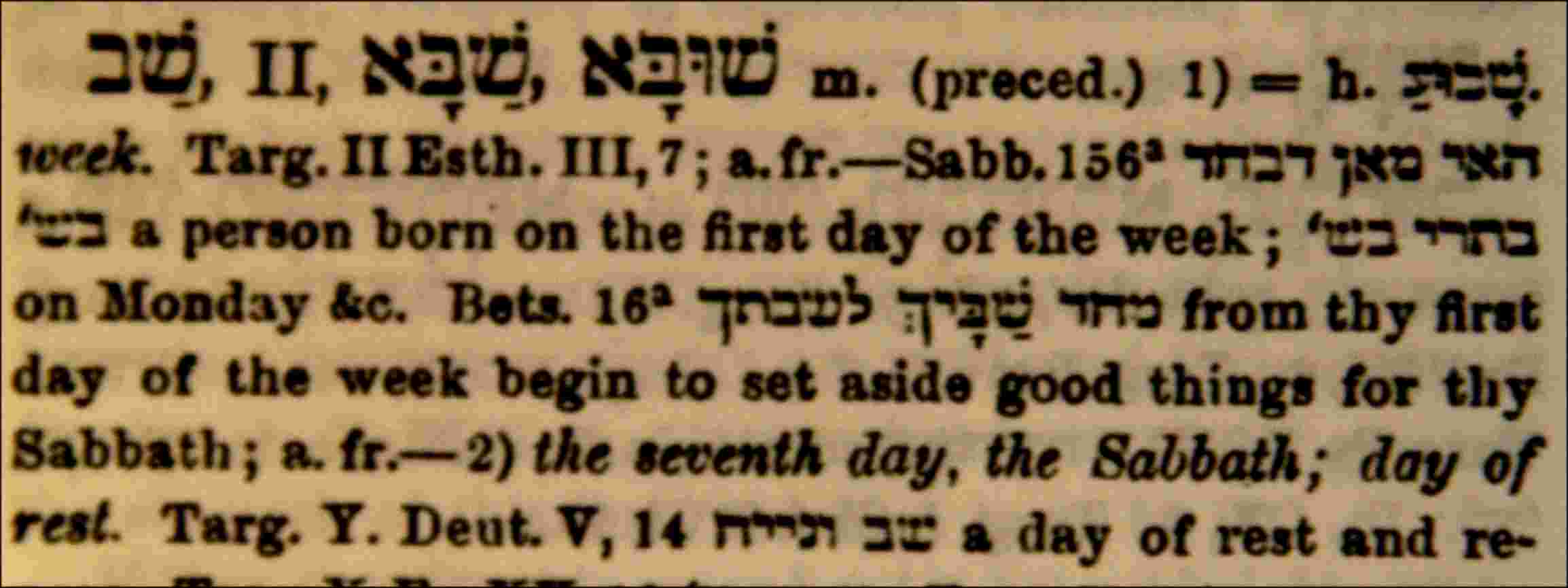
[1]. Jastrow, Marcus, Dictionary of the Targumim, the Talmud Babli and Yerushalami and the Midrashic Literature:
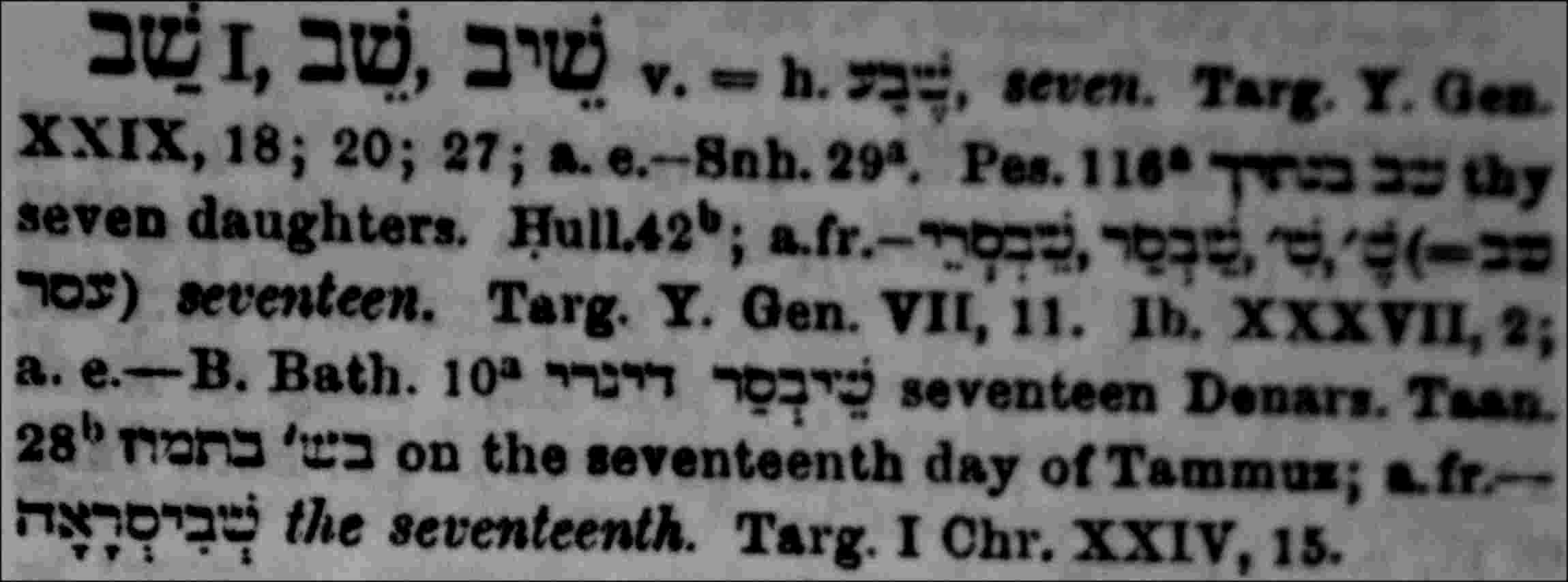
The dictionary first says to see the preceding entry. So we consult this:
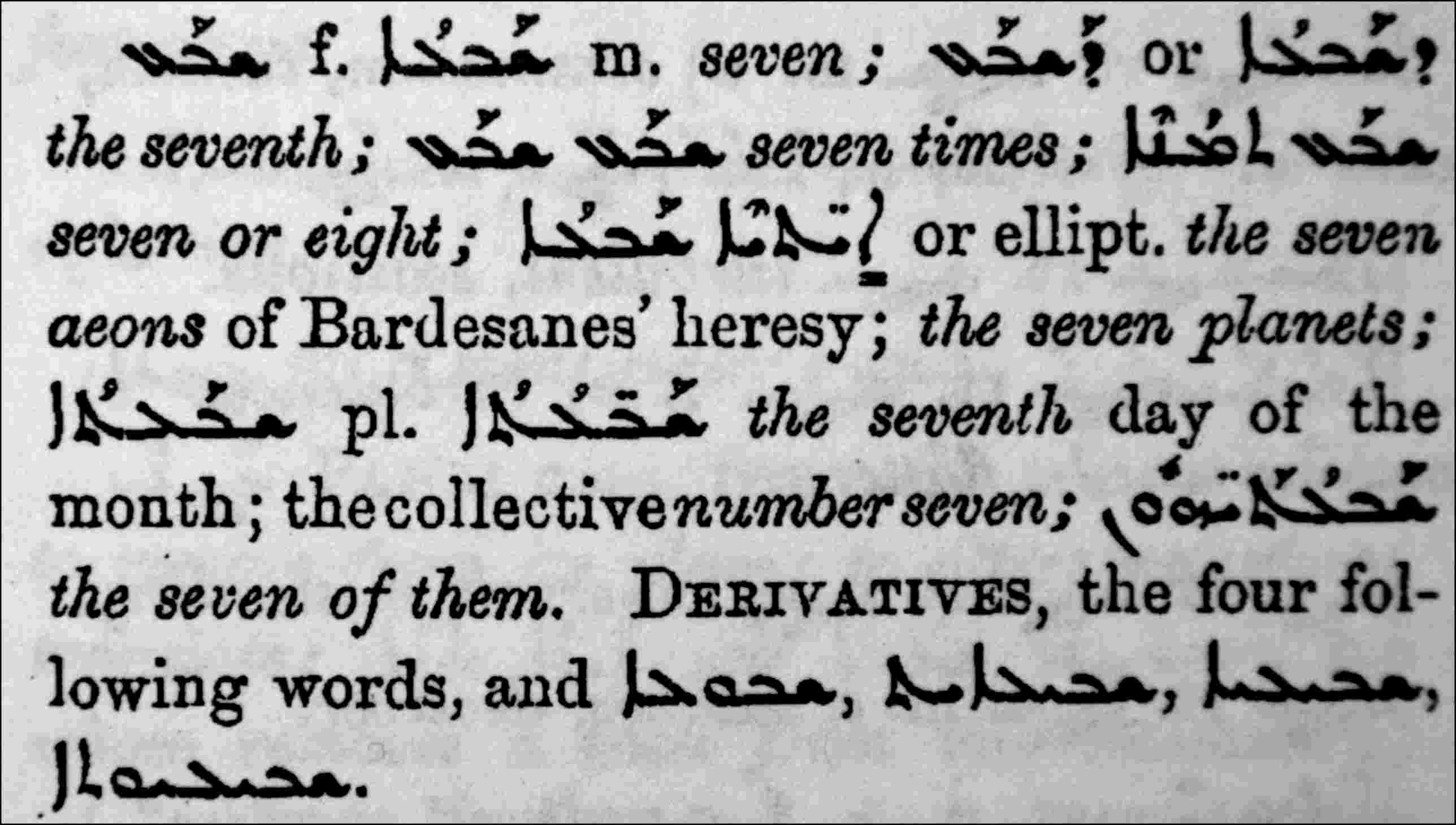
Here we see that the word is equated to "seven". Now go back to the first entry, it is equated to shavua in the first definition, which means "seven" of something. Now if we look at the Syriac (J. Payne Smith):
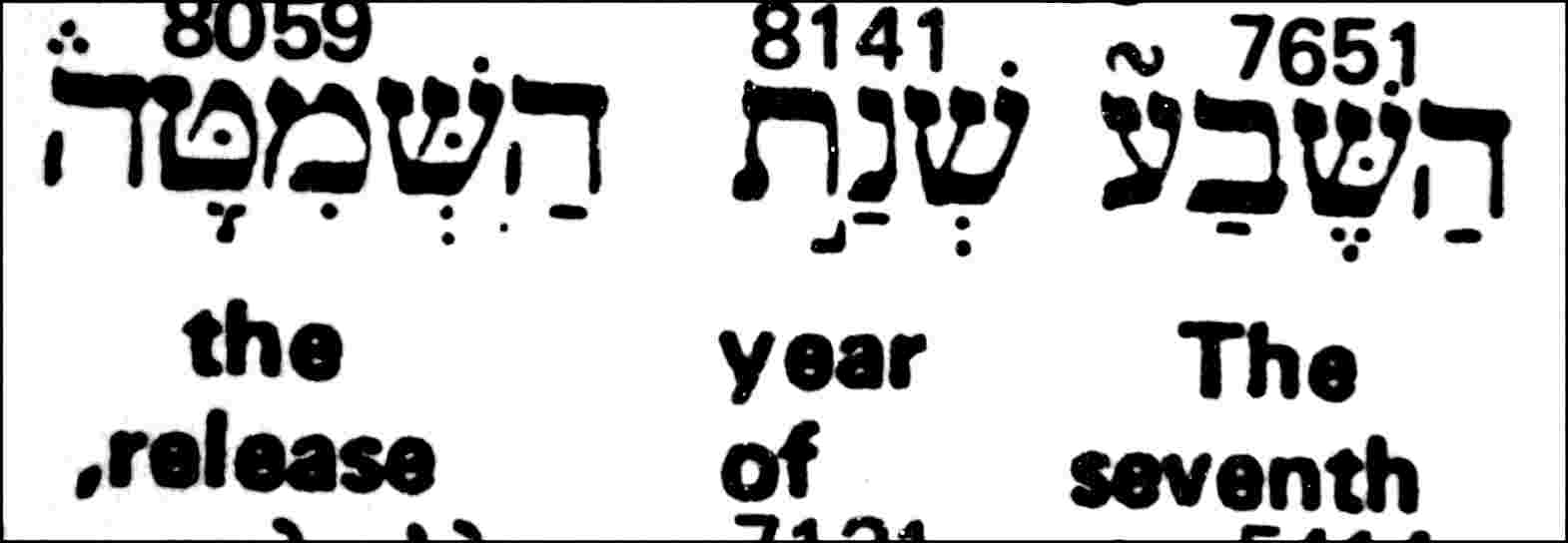
We see here that Sheva may mean "seventh" as well as "seven". The next photo is from J.P. Green's Interlinear showing that sheva is used for the seventh year.
The reason for going through all of this is to show that in Aramaic/Syriac that the form שבא means "seven" or "seventh". We must also distinguish between two types of glosses in the dictionaries, 1. Literal/Lexical and 2. Dynamic. A Lexographer will give dynamic glosses simply to "explain" things more fully. This in context שבא may mean the Sabbath, but it does not mean "Sabbath". It only means "seven" and the reference to the Sabbath is contextual because the Sabbath is the seventh day. It is failure to observe this lexical vs. dynamic distinction that leads to false equivocations. In Aramaic when one wanted to refer to Sabbath by way of seven, then one said שבא. However, if one wanted to refer using the word "Sabbath" or mean "rest", then one used the word שבתא.
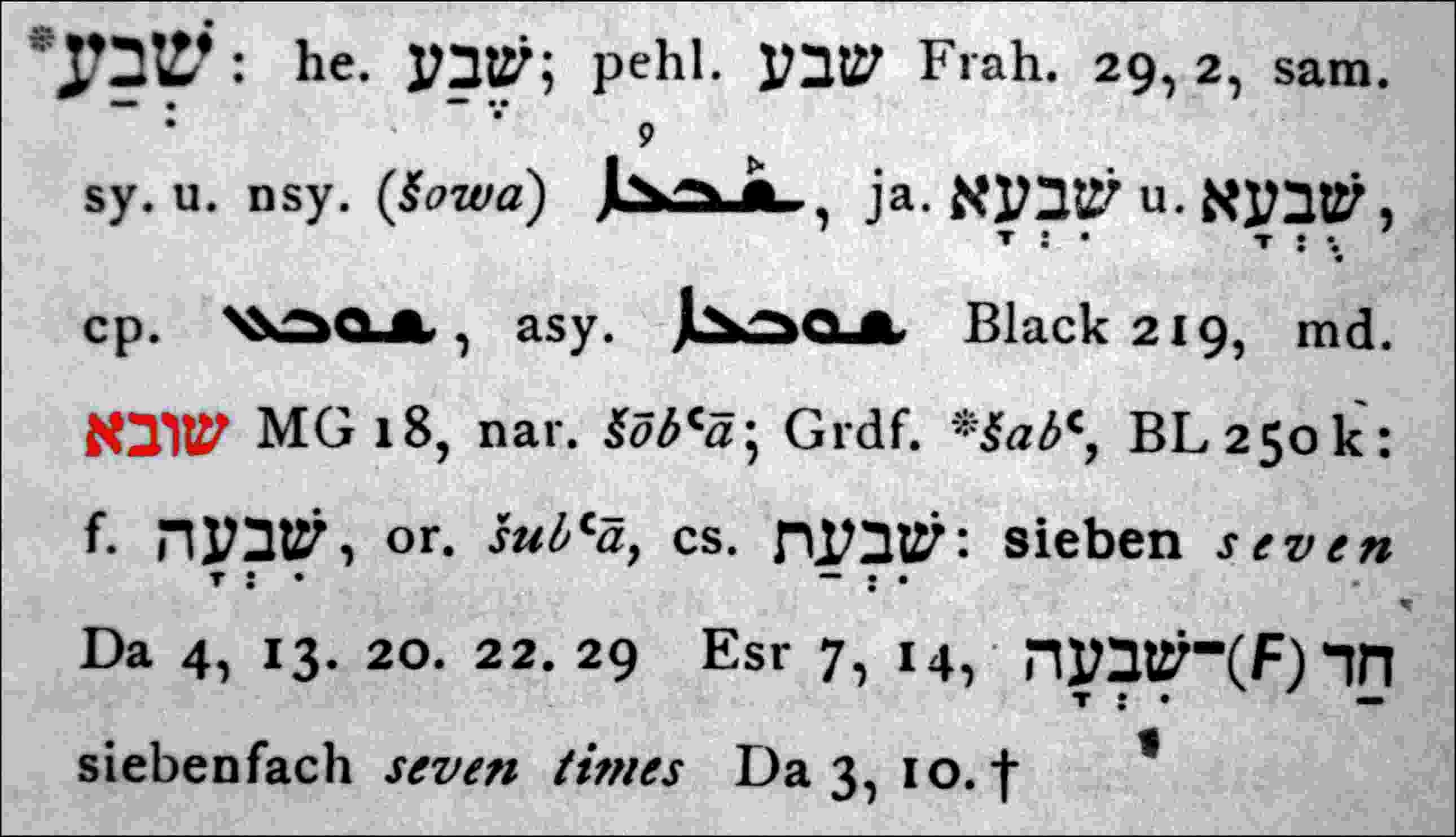
Also notice HALOT:
Here I have highlighted שובא. The reader should now compare this with the first entry in Jastrow above.