| Page 31-35/Index / Home / | Next page | Previous page |
|
This false doctrine is useless for understanding our pardon in Christ and a total hindrance to focusing on sanctification and holiness. God does not care about fictitious legal righteousness. He cares about the real righteousness of Christ flowing into your life.[1] There are many who ignore these truths and who undermine them with what they say in the midst of the Church. They have made themselves a conduit for the spirit of iniquity and the mystery of lawlessness. By teaching against repentance, they have also taught against the gospel. In fact, they have destroyed many beautiful scriptures concerning the gospel. We will now revisit some texts in Romans to show where the gospel has been deleted from the understanding of Christians.
Under the Law
It is not hard to understand the phrase under law as meaning under judgment from the context it is used in:
KJV Romans 6:14 For sin shall not have dominion over you: for ye are not under the law, but under grace. 15 What then? shall we sin, because we are not under the law, but under grace? God forbid.
What Paul is saying is that the justice of the law is satisfied for us by Christ. That is what grace is. Therefore, the law no longer condemns us. Thus, Paul is teaching the gospel here, but he does not want anyone to think that because the just penalty of the law has been satisfied for us that they should continue to break it by sinning! Nevertheless, millions of Christians think this text means they do not have to be subject to God's law. Somehow, they have the idea that grace means freedom from repentance. Somehow, they think that mercy means they can go on sinning and God will count them as righteous in his sight anyway. Somehow, they think that it is impossible to lose their salvation. Nothing could be further from the truth. The fact is that many of these have never understood the gospel in terms of a divine pardon. They have thought of it as acquittal. In addition, many more have been confused by errant teachings that suggest acquittal to them. It is easy to see that "under the law" means “under judgment of the law” from this context in Romans 6:14-15, and one does not have to read the bible too regularly to know that God requires repentance. I knew a lady many years ago who told me she wanted to walk on the dark side for a while. What she meant was that she wanted to sleep around. I had given her bad advice about the impossibility of loosing one's salvation, as I was young and deceived by the once saved always-saved doctrine. Although, I did not indulge in willful sin, I had said one could still be saved if they committed it. When she said this, it was as if someone had socked me in the gut. I felt spiritually alienated and cut off from her, as she was one of my good friends. I think that she should have had more fear of committing such sins and my opinion did not help there. The idea that the gospel terminates any need for repentance unto righteousness, sanctification, and holiness, trips up a lot of weak believers in Christ because there are also many insincere believers in Christ who take His name, but who live in sin, and who perpetuate the false doctrinal traditions to make themselves feel comfortable, or to give them psychological relief from continuing guilt. This is taking the name of the LORD in vain (Exodus 20:7). This is the reason that the Evangelical Church is in such horrible trouble. Statistics show that Church people are indeed involved in the world's sin and are sinking fast. The reason they have continuing guilt after professing the gospel is that they are still sinning willfully against what they know in their hearts is wrong. The Holy Spirit is making them guilty because of it, in spite of their profession of the gospel, so that they might repent. Instead of repenting, they are seeking solace in false doctrines to give them Satan's psychological relief from guilt. What they need is real trust in God and in his word, and not just lip service and religious appearance.
The phrase "under the law" is even easier to
understand when we consider the Greek sense of the word for
"law". This word is
From the Theological Dictionary of the New Testament:
From Liddell and Scott's Greek-English Lexicon:
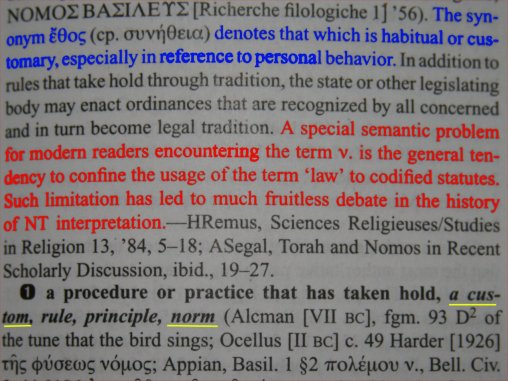
From BDAG (Bauer):
Romans 6:14 For sin shall not have dominion over you: for ye are not under the norm, but under grace. 15 What then? shall we sin, because we are not under the norm, but under grace? God forbid.
What is the norm for the one under the dominion of sin?
KJV 2 Chronicles 25:4 But he slew not their children, but did as it is written in the law in the book of Moses, where the LORD commanded, saying, The fathers shall not die for the children, neither shall the children die for the fathers, but every man shall die for his own sin.
When Jesus' pays the penalty for your sin, then the norm no longer applies. Jesus (Yeshua) is the exception to the rule! In fact, the whole teaching of sacrifice for atonement in the Scripture is the exception to the norm.
The End of the Law
Another misunderstood text is Romans 10:4. Yet, when we straighten it out, it teaches both the gospel, and promises sanctification. First, let us consider the sanctification aspect.
Romans 10:4 For Christ is the end of the norm for righteousness to every one that firmly trusts.
Those who are truly in Christ have repented of
transgression; and they live (and think) above the world's
norm of righteousness. True Christians enjoy a greater
level of sanctification than the norm of righteousness for
the world. Also in the first definition of
Paul does not just teach greater sanctification
by this passage. His primary sense is the gospel. How can
we say this? Well, what is the norm for righteousness in
God's courtroom? Is it not that the defendant must
demonstrate their total righteousness to obtain an
acquittal? That's the norm for God's righteousness where
judgment is concerned. To make this plainer, let us
consider the primary meaning of the Greek word
[1] The idea that the righteousness of another can compensate for transgression fails to recognize the unrepairable damage that sin does to the destiny of others. Atonement was never an equitable justice that totally reversed all the damages of sin. It was a merciful penalty assigned less than the death of the sinner that allowed the repentant to have life. God’s choice of the manner of atonement was meant to underscore the cost of sin, yet to allow His mercy to operate. It was never meant to, nor can it, reverse all the evils caused by our sin. For this reason, the attempt to legally balance God’s books by even the righteousness of Christ is insufficient. God is not requiring an equitable form of justice in the death of Christ, because there is no equitable justice that can make sin as if it had never happened –and that is what equitable justice would require if God had insisted on it.
[2] This sense, and related usages
in Paul dispose of numerous apparent contradictions
caused by translators who lack a feel for the
semantic domain of
[3] BDAG, third edition, 2000.
|
 . The first definition in Bauer's Lexicon is
that "nomos" is a norm for something.
. The first definition in Bauer's Lexicon is
that "nomos" is a norm for something.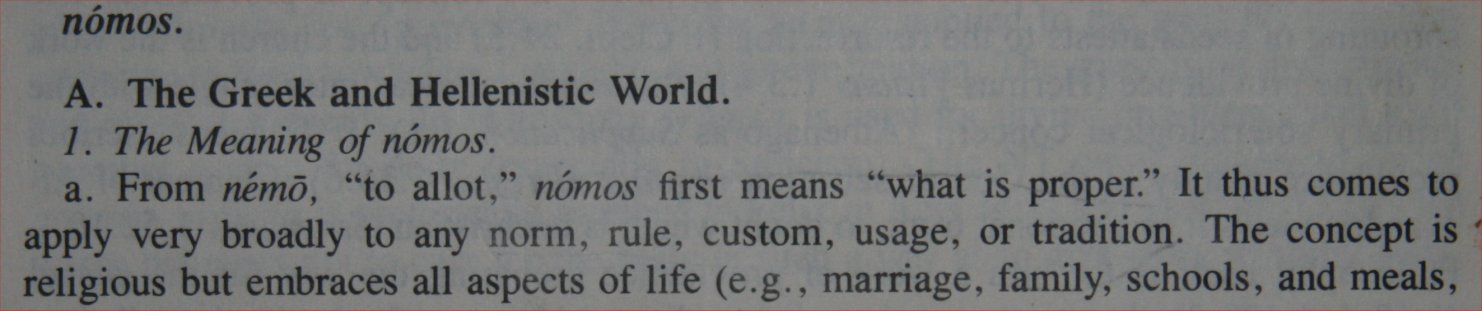



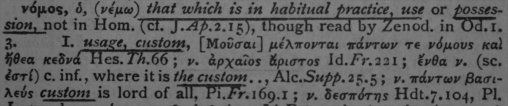
 ,
which was translated "righteousness" in English. This word
is a noun, and it means "justice" plain and simple. It
comes from the same Greek stem or root as the Greek word we
discussed before:
,
which was translated "righteousness" in English. This word
is a noun, and it means "justice" plain and simple. It
comes from the same Greek stem or root as the Greek word we
discussed before:
 . The
very first definition of
. The
very first definition of
 ,
and
,
and
 .
Another part of the reason is that Paul's use
.
Another part of the reason is that Paul's use