| Page 36-40/Index / Home / | Next page | Previous page |
|
So let's plug this into the text and see where it gets us:
Romans 10:4 For Christ is the end of the norm for justice to every one that firmly trusts.
What norm for justice did Christ end for the one trusting? Wasn't it the law that says a sinner must die for his own sin?
KJV 2 Chronicles 25:4 But he slew not their children, but did as it is written in the law in the book of Moses, where the LORD commanded, saying, The fathers shall not die for the children, neither shall the children die for the fathers, but every man shall die for his own sin.
Is that the whole law, or just the judicial part of the law? It is not the whole law, but only the judicial part of it as it is normally applied to sinners! How do the unrepentant "believers" in name only want to take this text? They want it to mean that God does not require them to repent and put on Christ's righteousness by obeying His law. But this is a contradiction. Was it not God's unwillingness to set aside His law that required the law to be applied to Christ as our substitute to uphold His justice? That was the case. Nevertheless, many Christians have turned this text into an excuse for ignoring God's laws. What Christ ended was not following God's law for righteousness. He only put an end to the norm for justice (death penalty) for everyone who firmly trusts in Him.[1]
Firm Trust in God
Now we must take one more step to restore the
idea that more than mere belief is also required as
part of the true Gospel. Repentance does not pay the
penalty, but if we trust what God says, we know that He
requires it. Only Christ pays the penalty, but it is
required in order to receive the benefits of his
atonement. The word "believe" is a very weak translation
of an important Greek word. It might imply believing
certain facts, or supposed facts is sufficient for
salvation. The Greek word is "pisteuo". That is spelled
Now it is important to understand that this word
The point of the verb pisteuo has been
made by many scholars and preachers. It does not mean
merely "belief" in a set of facts. Again and again,
preachers have explained that it is more than "believe," and
that it implies a belief that follows through with
commitment to the person one trusts in. Besides the
definition given below, the word may be rendered "loyally
trust," or "steadfastly trust". If we were to look at the
Hebrew equivalent,
Genesis 15:6 And he firmly trusted in YHWH and He considered it to him to be righteousness.
Abraham's trust was counted as righteous-ness before God. The Hebrew word sense is stronger than the English (NASB) believe. It implies the idea of firmly trust or faithfully trust in the Hiphil verb stem. It might even have the sense of stand firm in Gen. 15:6, but a sense of complete (firm) trust is the idea communicated by the context. Abraham did not just believe something God said. He put his complete trust in God. So Jesus' puts an end to the norm for justice for all of us who firmly trust Him. Notice the condition here? It is for all who firmly trust. This includes believing everything that God has said is necessary for salvation, and not just the facts of forgiveness stemming from Jesus' death. It means relying on Him continuously. It means believing we must remain in his word. That includes being sorry for sin and turning away from it. Someone who just wants to believe that God acquitted them from sin (declared them innocent) and who wants to think that God no longer sees any sin, but sees only righteousness might be tempted to think that it is o.k. to sin and that God will overlook transgression. However, one with that attitude is no longer firmly trusting God, because they are not trusting the truth of what God said about turning away from sin! Nor does that person really understand the gospel.
How Man becomes Guilty
God's law says:
KJV Deuteronomy 24:16 The fathers shall not be put to death for the children, neither shall the children be put to death for the fathers: every man shall be put to death for his own sin.
Do you see the principle of justice here? God is saying that a man's descendants shall not be guilty for the sin of their fathers.[3] God is angry with Israel in Ezekiel 18 for perverting His justice. He says:
KJV Ezekiel 18:20 The soul that sinneth, it shall die. The son shall not bear the iniquity of the father, neither shall the father bear the iniquity of the son: the righteousness of the righteous shall be upon him, and the wickedness of the wicked shall be upon him.
KJV Ezekiel 18:29 Yet saith the house of Israel, The way of the Lord is not equal. O house of Israel, are not my ways equal? are not your ways unequal? 30 Therefore I will judge you, O house of Israel, every one according to his ways, saith the Lord GOD. Repent, and turn yourselves from all your transgressions; so iniquity shall not be your ruin. 31 Cast away from you all your transgressions, whereby ye have transgressed; and make you a new heart and a new spirit: for why will ye die, O house of Israel?
God is still angry! He is also angry with the reformers and the Church for perverting the justice of God. What are the theologians and teachers doing that God dislikes? They are teaching a corrupt doctrine of original sin. They are saying that all men are guilty before God because the guilt of Adam's sin is reckoned upon his descendants. But did all men commit Adam's sin? By no means! Adam introduced sin and death into the world, and we inherit the sin nature caused by death, but the penalty that God assigned to Adam for his own sin is not assigned to us on the basis of Adam's own sin. We inherit the disease of sin which causes us to sin. We are judged because we sinned. We are not judged for Adam's sin. Christ died to pay the penalty of Adam's sin for Adam alone, and he died to pay the penalty for your sin and my sin for you and me alone. This doctrine of the imputation of Adam's sin into our account goes hand in hand with the doctrine of the imputation of righteousness. Justice is perverted both ways. First, guilt is counted to the descendants apart from their own sin. That is perversion number one. Second, they teach that righteousness is counted to the sinner without the sinner first being made righteous. That's perversion of justice number two. Finally, stumbling over their own stumbling blocks of justice, these teachers make salvation a matter of acquittal on the basis of that righteousness. I tell you that the higher up in the Church you go, and the more seminary traditions and theologians you read, the more complete is the famine of truth. Yet they pay lip service to the Gospel, and not true trust in God the whole way up. How did this come about. Are so many believers in error? But many of them were not believers to begin with, but came to the church still belonging to Satan's kingdom seeking psychological relief from their guilt but not wanting to really repent. These are tares among the wheat (Mat. 13:25). They did not understand because the gospel was hidden from them, and they rose through the ranks and sowed confusion in the Church. And having sowed confusion, they reaped relativism. And even those who did not succumb to the full conclusion of their twisting of God's justice, even these condemned the innocent who objected to their false doctrines:
KJV Acts 20:28 Take heed therefore unto yourselves, and to all the flock, over the which the Holy Ghost hath made you overseers, to feed the church of God, which he hath purchased with his own blood. 29 For I know this, that after my departing shall grievous wolves enter in among you, not sparing the flock. 30 Also of your own selves shall men arise, speaking perverse things, to draw away disciples after them. 31 Therefore watch, and remember, that by the space of three years I ceased not to warn every one night and day with tears. So where do they get this doctrine of Adam's guilt being transferred to his descendants? Let us examine this more closely. The sin nature, that disease of sin and death is transferred, but God's assignment of the eternal penalty of death to Adam is not transferred. Remember the first death is the temporary natural result of sin unremedied. But the eternal death penalty is only assigned when each man is found with his own sin. Let us consider Paul:
[1]
[2] BDB, Brown-Driver-Briggs Hebrew Lexicon. The Lexicon supplies two basic senses of the hiphil verb. 1. stand firm, 2. [firmly] trust. [3] There seem to be some exceptions to this norm. Particularly the sin of Achan and the sin of Saul against the Gibeonites. However, it appears that Achan's family was complicit in the concealment, and Saul's sons in the murder of the Gibeonites. Even if one should argue it not so, the cases stand as exceptions to the rule that God has given in the scripture. We may allow that God can make an exception, but we must not corrupt our notion of justice by making our own exceptions or by supposing the exception is the general case.
|

 in Greek.
The word means faithfully trust, loyally trust, firmly
trust. I have photocopied the BDAG entry for your
inspection:
in Greek.
The word means faithfully trust, loyally trust, firmly
trust. I have photocopied the BDAG entry for your
inspection: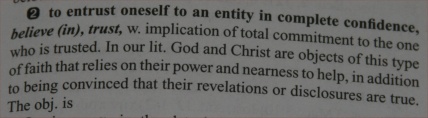
 we discussed before, which means "faithfulness," and
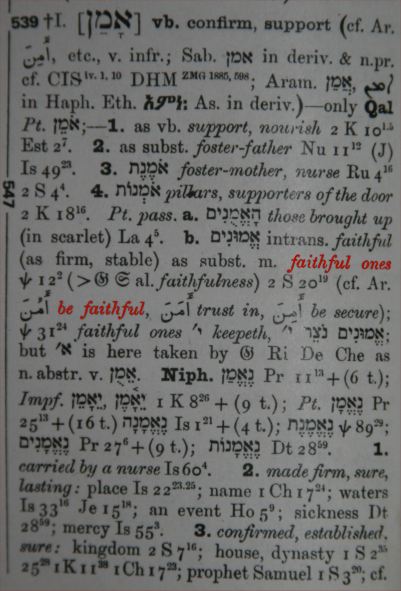
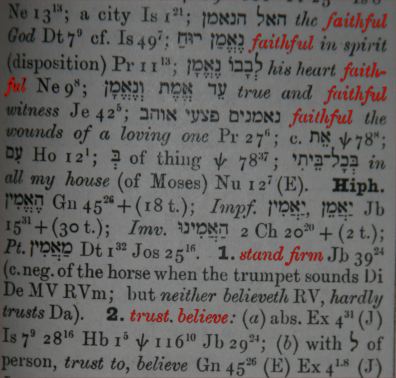
if we look at the Hebrew in Genesis 15:6 we see that the
Hebrew dictionary supplies "firmly trust"
we discussed before, which means "faithfulness," and
if we look at the Hebrew in Genesis 15:6 we see that the
Hebrew dictionary supplies "firmly trust"


 in context: "righteousness" = justice
in Rom. 1:17; 3:5, 21, 22, 25, 26; 4:5, 6; 4:13;
5:17, 21; 6:20; 9:30, 31; 10:3, 4, 6, 10; 14:7. It
doesn't take a scholar to see where justice
fits. Anywhere the text makes sense with it, use
it.
in context: "righteousness" = justice
in Rom. 1:17; 3:5, 21, 22, 25, 26; 4:5, 6; 4:13;
5:17, 21; 6:20; 9:30, 31; 10:3, 4, 6, 10; 14:7. It
doesn't take a scholar to see where justice
fits. Anywhere the text makes sense with it, use
it.