| Page 9/Index / Home / | Next page | Previous page |
|
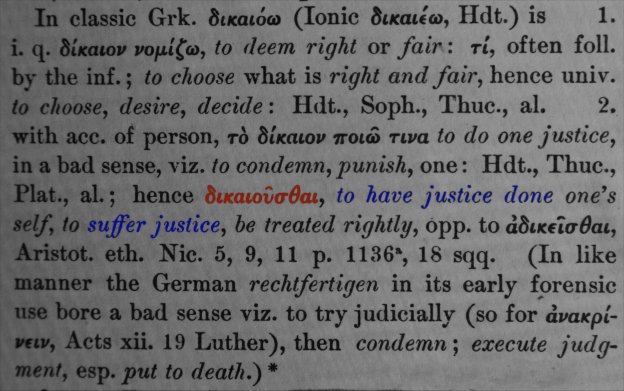
bit. For the moment, I just want you to understand what the word means so that you can follow the logic of my argument. For you must understand what I am saying before I prove it. After you understand what I mean, then the proof will be more appreciated. It means "to satisfy justice" or "to have justice done". God's justice was accomplished by the death of Christ. Justice was satisfied by Him paying the penalty. In this sense, it has nothing to do with the English idea of someone being justified, which is acquittal. A person who is justified in English is acquitted of wrong doing in the first place, but a person who is "di-kai-oo-ed" in Greek has justice done for him, or has satisfied justice by having it done to him. To help the English reader, think of it as JUSTICE APPLIED. "Justified" is "Justice-applied" to a sinner. Indeed, we were justified in Christ, because it means "justice-is-applied". God's justice against our sin was applied to Christ who died in our place as the divine substitute. Now let's get to the Greek. The entry on the page below from Thayer's Greek-English Lexicon explains this meaning. Read the photocopy and notice the definitions given in italics. The definition, "to have justice done oneself, to suffer justice, to be treated rightly" is in definition number 2. It exactly fits what Christ did for us on the cross. Romans 3:28 from Greek:
Indeed, we reckon that justice is done by [Christ's] faithfulness.
|