1:1
In the beginning was the
Word¹, and the Word was with the
Almĩghty², and the
Word was
Almĩghty³.
(MISB, John 1:1).
http://www.torahtimes.org/NewTranslation/BasicBooks/john.html#1:1a
(Link to MISB:
http://www.torahtimes.org/NewTranslation/bibleframe.html)
1. A better translation would be “expression” (cf. John 1:18), but “Word” will have to do. The “word” is what “expresses” “thought”. Thought is analogous to G-d unseen, and the Word is “G-d expressed” that is seen. The Hebrew word is דָּבָר, and Aramaic מֶלתָֿא.
The Gnostic heresy separated Messiah from the man Yeshua. The Messiah they said was only the Spirit of G-d which dwelt in the man Yeshua who they said was only a man. Further, they said that only the man Yeshua died and not the Mashiyakh-Ruakh (Spirit). Thus the Gnostics separated the man Yeshua from the divine Spirit. John says we should not receive this doctrine or those who teach it (1Jn 4:2; 2Jn 1:7).
The Aramaic Targums often substituted “word (מַאֲמָרָא) of Yahweh” for “Yahweh” in Scripture passages that identified the “Messenger of Yahweh” as “Yahweh”. This was done after the coming of Messiah because they did not want those passages to refer to Messiah, nor did they want them to teach that Messiah is Yahweh in the flesh. In the Targum usage the “word of YHWH” meant merely YHWH’s power, i.e. his metaphorical arm, so to speak, and as such was not really YHWH, but only an emanation from YHWH. Thus was subtly denied that the “Messenger/Angel of Yahweh” is “Yahweh”! John combats this by using the word “Word” metaphorically to refer to the person of Yeshua who became flesh, and goes on to define “the Word” itself as “Almighty” (Elohim). By defining “the Word” also as Elohim, John refutes the Targumic notion that the word is only the power or emanation from Yahweh.
2. The sense is that the “Word” was “next to” the Almighty. This further clarifies that the Word is not just an emanation of G-d’s power. the Word itself is of equal rank right next to the Almighty Father. Here are some axioms to understand Elohim. First there is One Almighty that would be “all” of the Almighty. Second the Almighty is divisible. Third, the divided parts are also Almighty. Fourth, there is a greater division, the Father, and the smaller division, the Son, and also the Ruakh (Spirit) which is of sevenfold division. In the Son is the complement of the Almighty, which is the part that completes the whole.
Judaism and Trinitarianism are both wrong on the indivisibility of G-d. They both derived this doctrine from Greek Philosophy. They are also wrong on the number of persons that the Almighty can divide into. Judaism says only one, and Trinitarianism says only three. The Scripture gives no number but only uses אֶחָד to say that Yahweh “alone” is our Almighty (cf. Deut. 6:4), and this includes all the parts.
3. The “Word” is not just Yahweh’s wisdom with Yahweh, nor just His power with him, nor just an emanation from Him. The “Word be’eth Almighty”. I say “be’eth” because this is technically more accurate, but it was be too much Grenglish/Hebrish to put it in the text. The “Word is Almighty”. Yeshua had all his almighty power at his disposal. He just didn’t use it all as a man, but only so much as the Father directed.
14
And the Word became flesh¹, and dwelt among us, and we beheld his glory, glory as
of the
only special
one from the Fãther, full of loving-kindness and truth.
(MISB, John 1:14).
http://www.torahtimes.org/NewTranslation/BasicBooks/john.html#1:14
(Link to MISB:
http://www.torahtimes.org/NewTranslation/bibleframe.html)
1. “The Word became flesh”. What the human spirit can or cannot do is limited by, defined by, and corresponds to the fleshly structure of our bodies. So also the Word (Elohim) limited himself so that his knowledge and capacities corresponded to the physical body that he took on. The word was knitted into flesh, and linked up with the five senses, so that Yahweh would experience everything as a man experienced. There was no separate man spirit. Yahweh became the man spirit.
This is what the Gnostics denied. They denied that G-d actually became a man. They separated the Mashiyakh Spirit in Yeshua from the man spirit in Yeshua. That was their heresy. They separated the divine-Anointed from the human-anointed, and then claimed that only the human-anointed died on the tree. But Yahweh says, “They will look toward Me whom they pierced” (Zech. 12:10). This is why John wrote the way he did—in order to refute the Gnostics.
18 For this cause therefore the
Jews
were seeking all the more to kill him, because he not only was loosing¹ the
Sabbath,
but also was calling the
Almĩghty his own
Fãther, making himself equal² with the
Almĩghty.³
ª
(MISB, John 5:18).
http://www.torahtimes.org/NewTranslation/BasicBooks/john.html#5:18
(Link to MISB:
http://www.torahtimes.org/NewTranslation/bibleframe.html)
1. The Greek reads ἔλυεν (הִתִּיר), which means “he was loosing” or “untying”. The charge was true. But it wasn’t the Torah that Yeshua was loosing. He was loosing the Pharisees’ tradition that disallowed healing on the Sabbath and other redemptive work. He told the man to pick up his bed stuff when he was healed. This tells us that the command not to bear a burden is not so strict as the Pharisees made it out to be.
2. Once again, the statement is true. Yeshua was loosing the unprofitable Shabbat traditions, and he was making himself equal with Elohim. In John 1:18, it has been stated, “the only special Almĩghty, who is in the bosom of the Fãther, he has expressed him”. Yeshua is the Almighty Son who expresses the Almighty Father. No one has ever seen the Father (John 1:18). Who then did Moses speak face to face with? It was Yeshua. When Yeshua called Elohim, “My Father” and said “My Father is working until now, and I Myself am working” he refers to His word that holds all things together (from eternity), and the word of His power by which the man was healed. Yeshua claimed that it was his working that healed the man.
3. There is a false doctrine about Yeshua’s equality with Elohim that says it was only a false charge of the Pharisees. That’s not what the text says. Also a false doctrine is the teaching that Yahweh did not take on the human nature in Yeshua. Nowhere do the Scriptures say that Yahweh only dwelt in a human that was not Yahweh. No! But Yahweh knitted himself to human flesh to experience things from the human point of view. He became a man. Also, the Ruakh (Spirit) of Yahweh dwelt in Yeshua (Isa. 11:1-2), yet he Himself was also Yahweh (cf. Isa. 48:16) connected to physical flesh and blood. The Spirit was only in King David (cf. Ps. 51:11), and David was only a human speaking. When Yeshua spoke, Yahweh was speaking as a human being. Yeshua was not mortal by nature. He did not see old age, but was killed. Not even his body saw decay (Ps. 16:10), and he is the Eternal Life (Dan. 12:7; 1John 1:2; 5:20). Nowhere does Yeshua say he is mortal, which means subject to dying. He experienced our pains, but it was not because his soul was mortal. It was because he allowed it to suffer.
a. Yahweh says, “They will look toward Me whom they pierced. And they will mourn over Him, as wailing over the special
one.” The Almighty Son (בֶּן־אֱלֹהִים), who is the part of the One Elohim, was pierced and killed. When Yeshua died, the Almighty Son died—that part of Elohim that became Yeshua. He subjected himself to death and did not save himself from it. Him whom they mourn over is Yahweh whom they pierced. (In Messianic Prophecy Yahweh often speaks of himself in the third person). The Son is the resurrection and the life (John 11:25) and has His own power to raise the dead.
29
The next day he saw
Yẽshua coming to him, and said, “Behold, the Lamb of the
Almĩghty who takes
away the sin of the world!¹
(MISB, John 1:29).
http://www.torahtimes.org/NewTranslation/BasicBooks/john.html#1:29
(Link to MISB: http://www.torahtimes.org/NewTranslation/bibleframe.html)
1. How does Yeshua take away the sin of the world? In all respects. (1) First if any person of the world repents, then Yeshua by means of his own sacrifice forgives that person’s transgressions and iniquities. (2) Second: by forgiving sins of ignorance by his own sacrifice in the absence of possible Levitical offering for that purpose, or (3) Third: if the Levitical service is put back in order the preferred method of atoning for sins of ignorance will be the proper Levitical offerings; in this case Yeshua takes away the sin by restoring the Levitical service. (4) Fourth: The sin of the world will be removed by removing the wicked through judgment. (5) Fifth: Yeshua by means of his living life (blood) transforms the repentant into his likeness so that we become righteous and sin no more. Thus sin is taken away out of us—a function that the Levitical offering cannot do. Yeshua’s transforming life (blood; cf. 1John 1:7) cleanses us from all sin. This is a present progressive: cleanses, cleansing. It is only complete in the end of days when Yeshua returns and gives us a perfect body. And this is the meaning of “eating his flesh” and “drinking his blood” from John 6. We have to consume his life to have life.
20:1
Now on the
first of the sabbaths¹ Miriam
Magdalene came² early to the tomb, while it was still dark³, and saw the stone
already taken away from the tomb.
(MISB, John 20:1).
http://www.torahtimes.org/NewTranslation/BasicBooks/john.html#20:1a
(Link to MISB:
http://www.torahtimes.org/NewTranslation/bibleframe.html)
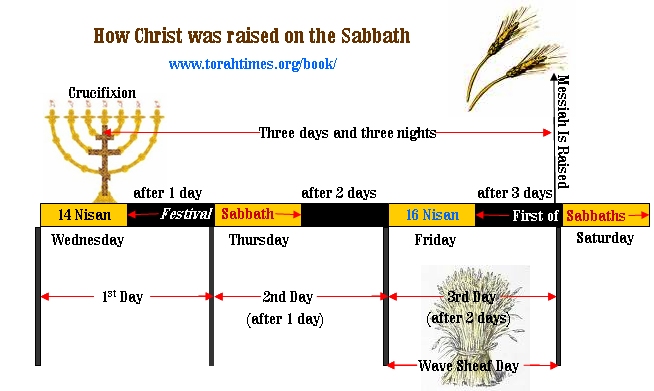
1. In Hebrew “first of the Sabbaths” = אַחַת־הַשָּׁבַּתוֹת or “one of the Sabbaths”, “one of the Sabbath days”, and in Aramaic בְּחַדֿ־יַומָא־דְּשַׁבְּתָֿא This was the resurrection day “while still dark”. It was before dawn on the Shabbat that Yeshua was raised. These idioms translate into Greek as “Τῇ δὲ μιᾷ τῶν σαββάτων”, which means “one day of the sabbaths”, and not “first day of the week”. Seven Sabbaths were counted in the day after the Passover (Lev. 23:15). The resurrection day was the first of these.
2. M. 23:5 They may make ready [on the Sabbath] all that is needful for the dead, and anoint and wash it, provided that they do not move any member of it. They may draw the mattress away from beneath it and let it lie on the sand that it may be the longer preserved; they may bind up the chin, not in order to raise it but that it may not sink lower. So, too, if a rafter is broken they may support it with a bench or with the side-pieces of a bed that the break may grow no greater, but not in order to prop it up. They may not close a corpse’s eyes on the Sabbath; nor may they do so on a weekday at the moment when the soul is departing; and he that closes the eyes [of the dying man] at the moment when the soul is departing, such a one is a shedder of blood. Danby, Mishnah 23:5
3. It was “still dark”, which is to say before the dawn was more than a reddish hint in the east. All four evangelists place the resurrection at the dawning. Matthew 28:1 states, “as it began to dawn on the first of the Sabbaths”. Mark 16:2 says, “And very early on the first of the Sabbaths”. Luke 24:1 says, “but on the first of the sabbaths, at deep dawn . . .”. None of these indicators of “dawn” can mean evening or setting time. The resurrection was before sunrise on the Sabbath. This agrees with the Messianic Prophecy in Hos. 6:3, “His going forth is fixed at dawn”.
a. Chart of Passion Week:
http://www.torahtimes.org/NewTranslation/misb_images/SabbathRessurection01.jpg
19
When therefore it was later¹, on that day, the first of the sabbaths², and when
the doors were shut where the disciples were, for fear of the
Jews,
Yẽshua came
and stood in their midst, and said to them, “Peace be with you.”
(MISB, John 20:19).
http://www.torahtimes.org/NewTranslation/BasicBooks/john.html#20:19
(Link to MISB:
http://www.torahtimes.org/NewTranslation/bibleframe.html)
1. This should not be translated “evening” as this term means after sunset to most people, although some dialects of English use it to mean “after noon”. Friberg’s Lexicon says, “as a time of day, either before or just after sundown late”. It this case it means “before sundown” as it was still the resurrection day: “the first of the sabbaths”. Since the weekly Sabbath ended at sunset, it is clear that the word means “later” on the same day, and not after sunset.
2. The first Sabbath is explained in John 20:1. This shows that the meeting in the upper room commenced before the end of the Sabbath. The Greek “τῇ μιᾷ τῶν σαββάτων” is explained as a Hebraism for, “בְּאַחַת־הַשַּׁבָּתוֹת”. The Catholic oriented argument that the phrase means “first day of the week” is deception. The word “sabbath” (σαββάτων) was not used in the signification of “week” before ca. AD 140. Only afterward was it added to ecclesiastical Greek to deepen the deception and backstop their misinterpretation. Other than their theory of the resurrection, there is no independent confirmation of the sense “week” before they tampered with the language.