Daniel's Literal Translation and Commentary
"Daniel 9:26 And after the sevens—sixty and two, Messiah shall be cut off, but not for himself, and the people of the coming general shall ruin the city, and the holy place, and its end is with a downpour, and until its end, war is decreed—even desolations" (DLT: torahtimes.org).
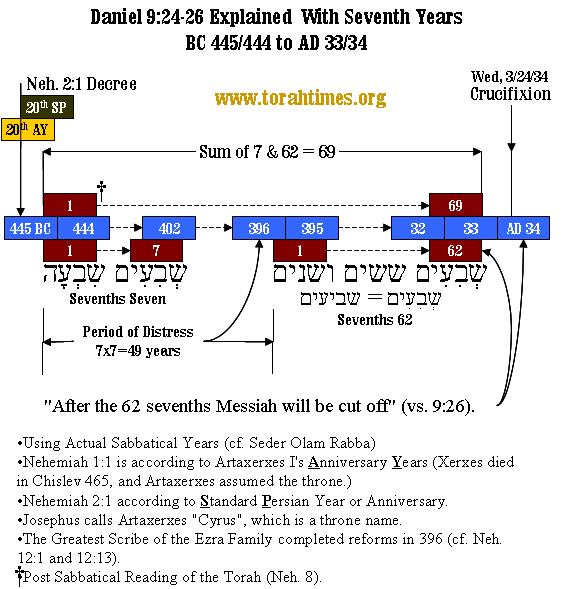
after : אחרי. After the sixty nine sevens from the rebuilding of the city (i.e. sum of 7 + 62), the Messiah will be cut off. The seven sevens were already explained in the previous verse as pertaining to the distressed times from Nehemiah to Ezra. Ezra ended the distressed times. The sixty two sevens follow sequentially. The cutting off of the Messiah is after the 62nd Sabbatical year counting Sabbath years from Ezra's reformation. The first of these is 395. Here is how they are counted:
395 388 381 374 367 360 353
346 339 332 325 318 311 304
297 290 283 276 269 262 255
248 241 234 227 220 213 206
199 192 185 178 171 164 157
150 143 136 129 122 115 108
101 094 087 080 073 066 059
052 045 038 031 024 017 010
003 005 012 019 026 033
So the Messiah was crucified in AD 34, the year after the 62nd Sabbath year from Ezra's reformation, and the 69th from the building of the walls. The Passover Sacrifice in AD 34 fell on the fourth day of the week, and the resurrection was on the seventh day.
cut off : More than one sense may be included here. First it means to die a violent death. But it may also mean removed far away. Messiah went back to heaven to wait for such time as when Israel and Judah might repent and be willing to receive Him.
but not for himself : ואין לו. This means that He was innocent of the charges that brought his death. His death was not for himself. It was for Israel, to pay the penalty for Israel's transgressions and iniquities. But it can also be and none for him, i.e. all everyone deserted him at his death, or and naught for him, i.e. He did not receive the kingdom at that time.
general : נגיד. Or this could be read prince, or leader, or chief. We must note that it blames the destruction on the people of the general, and not the general himself. The general was Titus who laid siege to Jerusalem and took it in AD 70. He did not want the temple burnt, as Josephus is anxious to point out, but his commanders thought otherwise. The Romans further ruined Jerusalem in AD 133-135 upon the occasion of the second Jewish revolt.
ruin : ישחית. There is more than one way to ruin something. This ruin is not a singular event, but pertains to the final exiles of Judah and Israel before the kingdom is restored to Israel. First came Titus and the Romans, who burned the Temple. Then the Romans salted Jerusalem after the second revolt and turned it into a pagan shrine. Rome also corrupted the Messianic faith into Catholicism and Pagan Gnosticism, and after this heretical faith took over Rome, they turned the Temple mount into a garbage dump. After the Catholics did their thing on the Temple site, then the Muslims built a pagan shrine to Allah, and they are there to this very day ruining the site, which is the one piece of real estate in the whole world which the Son of David holds personal title to. It was bought for 50 shekels of silver by King David, and is the property of the Son of David. (DLC: torahtimes.org)
composed: 4/22/09.
Daniel's Literal Translation and Commentary: (http://www.torahtimes.org/translation/dan0926.html)
All Rights Reserved, 2009 by Daniel Gregg. No part of this article may be copied without including the above reference to the author's original: torahtimes.org. It is preferable only to include what is in the boxes, however the live link in the second box may be omitted if necessary.