| Page 51_55/Index / Home / | Next page | Previous page |
|
acquit him because he is earning an acquittal by his good deeds. But the text does not mean God justifies the ungodly. It means he does justice to the ungodly as we explained before. And this justice is imputed by His faithfulness to do the work on the cross, just as we explained before. What many interpreters take away from this passage in the usual English translations is a fear of thinking they should do anything at all to put on righteousness! But that's not what Paul said in Greek. Paul is saying that God does justice to the ungodly by imputing justice done to the sacrifice to his account so that he may be forgiven. That's what David was speaking of. This justice is apart from works. Don't confuse it with righteousness or the need to do good works for righteousness.
Rom 4:7-8 "Blessed [are those] whose lawless deeds are carried away, And whose sins are covered; Blessed [is the] man to whom the LORD shall not consider Sin."
Paul is using the word Sin to mean "transgression" or "iniquity" as the Hebrew source text says. That is Sin with a capital "S" because iniquity is serious rebellion, not sins of ignorance or circumstance. Next, Paul moves from God's justice applied to us in Christ's payment of the penalty, to God's justice applied to us in sanctification and holiness. The justice applied for sanctification is "righteousness" in the proper English sense.
Rom 4:9-10 [Does] this blessedness then [come] upon the circumcised [only,] or upon the uncircumcised also? For we say that faithfulness was accounted to Abraham for righteousness. How then was it accounted? While he was circumcised, or uncircumcised? Not while circumcised, but while uncircumcised.
Here Paul is battling the very thing that the church teaches today. The church wants to say that our faith is reckoned as perfect righteousness before God. Some Jews must have had a similar argument. If you were circumcised, then you obtained the merit of justification before God. The same doctrine showed up in the church of Rome using baptism. Paul refutes it by demonstrating Abraham's imperfection. He wasn't circumcised when God counted his trust as righteousness. Therefore, what God counted was less than perfection. But the church weasels its way out of Paul's argument against the obvious imperfection of Abraham when God recognized his trust as righteousness by either saying it is infused into the inner man (where you can't see it), or by saying it is only a legal accounting trick on God's books in heaven. That's the subtle difference between the Pope and Luther or Calvin.
Rom 4:11-12 And he received the sign of circumcision, a seal of the righteousness of the faithfulness which [he had while still] uncircumcised, that he might be the father of all those who firmly trust, though they are uncircumcised, that righteousness[1] might be imputed to them also. Rom 4:12 and the father of circumcision to those who not only [are] of the circumcision, but who also walk in the steps of the faithfulness which our father Abraham [had while still] uncircumcised.
Now does this make sense? First comes trust in God which is obeying the command to love God, which is counted as righteousness and then comes our further steps of faithful obedience, which God also counts as righteousness. Because we trust in God, and not in our righteousness, God satisfies his justice against our sin through the sacrifice of Christ so that we are forgiven.
Rom 4:13 For the promise that he would be the heir of the world [was] not to Abraham or to his seed through the norm, but through the justice of faithfulness[2].
Paul is combining our pardon in Christ here with sanctification. The promise is not through the norm. The norm is that the sinner dies for his own sin. However, we received exceptional justice by Christ's atonement which is not the norm. The norm is also for Israel to be faithless, and not to trust in God, so the promise comes through firmly trusting in God which results in the righteousness of faithfulness. The two translations are not the fault of the Greek. The Greek means both. The fault lies in the English language that has split justice apart from righteousness. Rom 4:14-15 For if those who are of the norm[3] [are] heirs, the faith is made void and the promise made of no effect, because the norm brings about wrath; for where there is no norm [there is] no transgression.
Let us define the "norm" here. Lack of trust in God is the norm. Rebellion is the norm. The death sentence for sinners is the norm. Those who live according to the norm of sin reap God's wrath. Paul is getting a bit carried away with his use of nomos at the end of the text. By transgression, he means serious sins like the iniquities listed in Galatians 5:19-21. He means that the faithful do not live by the norm, and hence they will not be transgressing like the world.
Romans 4:22-24: Therefore, "it was considered to him as righteousness". It was not written for him only that "it was considered to him", but also for us, to whom God is going to be considering righteousness, to those firmly trusting the one who raised Yeshua, our Lord, from death.
God's considering of
righteousness to us is a present progressive recognition
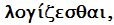
of our sanctification. This is what the words
Additional Texts on God's Justice (without comment)[6]
Rom 9:30-33 What shall we say then? That Gentiles, who did not pursue justice[7], have attained to justice, even the justice of faithfulness; but Israel, pursuing a norm of justice, has not attained to the law of justice. Why? Because [they did] not [seek it] by faithfulness, but as it were, by the works of the law. For they stumbled at that stumbling stone. As it is written: "Behold, I lay in Zion a stumbling stone and rock of offense, And whoever firmly trusts on Him will not be put to shame."
Rom 10:1-4 Brethren, my heart's desire and prayer to God for Israel is that they may be saved. For I bear them witness that they have a zeal for God, but not according to knowledge. For they being ignorant of God's justice, and seeking to establish their own justice, have not submitted to the justice of God. For Christ [is] the end of the norm for justice to everyone who faithfully trusts.
1 Corinthians 1:30 But of him are ye in Christ Jesus, who of God makes unto us wisdom, and justice, and sanctification, and redemption:
Galatians 2:16-21 "We know that a man does not satisfy justice by the works of the law except by the faithfulness of Jesus Christ, even we have firmly trusted in Christ Jesus, that we might satisfy justice by the faithfulness of Christ and not by the works of the law; for by the works of the law no flesh shall satisfy justice. 17 "But if, while we seek to satisfy justice by Christ, we ourselves also are found sinners, is Christ therefore a minister of sin? Certainly not! 18 "For if I build again those things which I destroyed, I make myself a transgressor. 19 "For I through the norm died to the norm that I might live to God. 20 "I have been crucified with Christ; it is no longer I who live, but Christ lives in me; and the life which I now live in the flesh I live by faithfulness in the Son of God, who loved me and gave Himself for me. 21 "I do not set aside the grace of God; for if justice comes through the norm, then Christ died in vain."
Gal 3:7-31 Therefore know that only those who are of faithfulness are sons of Abraham. 8 And the Scripture, foreseeing that God would do justice for the Gentiles by faithfulness, preached the gospel to Abraham beforehand, saying, "In you all the nations shall be blessed." 9 So then those who are of faithfulness are blessed with faithful Abraham. 10 For as many as are acquitted by the works of the law are under the curse; for it is written, "Cursed is everyone who does not continue in all things which are written in the book of the law, to do them." 11 But that no one is justified by the law in the sight of God is evident, for "the just shall live by faithfulness." 12 Yet the law is not of faithfulness, except when "the man who does them shall live by them." 13 Christ has redeemed us from the curse in the law, having become a curse for us (for it is written, "Cursed is everyone who hangs on a tree"), 14 that the blessing of Abraham might come upon the Gentiles in Christ Jesus, that we might receive the promise of the Spirit through faithfulness. 15 Brethren, I speak in the manner of men: Though it is only a man's covenant, yet if it is confirmed, no one annuls or adds to it. 16 Now to Abraham and his Seed were the promises made. He does not say, "And to seeds," as of many, unless as of one, "And to your Seed," who is Christ. 17 And this I say, that the law, which was four hundred and thirty years later, cannot annul the covenant that was confirmed before by God in Christ, that it should make the promise of no effect. 18 For if the inheritance is of the norm, it is no longer of promise; but God gave it to Abraham by promise. 19 What purpose then does the norm serve? It was added because of transgressions, till the Seed should come to whom the promise was made; and it was appointed through angels by the hand of a mediator. 20 Now the mediator of One[8] is not, but God is the only one. 21 Is the law then against the promises of God? Certainly not! For if there had been a norm given which could have given life, truly justice would have been by the norm. 3:22 But the Scripture has confined all under sin, that the promise by faithfulness in Jesus Christ might be given to those who believe. 23 But before faithfulness came, we were kept under guard by the norm, kept for the faithfulness which would afterward be revealed. 24 Therefore the norm was our tutor to bring us to Christ, that we might have justice done by faithfulness. 25 But after faithfulness has come, we are no longer under a tutor. 26 For you are all sons of God through the faithfulness in Christ Jesus. 27 For as many of you as were baptized into Christ have put on Christ. 28 There is neither Jew nor Greek, there is neither slave nor free, there is neither male nor female; for you are all one in Christ Jesus. 29 And if you are Christ's, then you are Abraham's seed, and heirs according to the promise.
Philippians 3:9 And be found in him, not holding to mine own justice, which is from custom, but that justice which is through the faithfulness of Christ, the justice which is of God by the faith:
The Place of Good Works in Salvation
The Lutheran and Calvinistic systems do not want to acknowledge that obeying God keeps anyone in Salvation unless it was totally caused by God and could not be attributed to man's obedience.[9] The reasons they came up with the idea of a fictitious legal righteousness was to remove the possibility of anyone considering that real righteousness preserved the spiritual life of the saved person. Let us then consider three Scriptures against this philosophy:
KJV Leviticus 18:5 Ye shall therefore keep my statutes, and my judgments: which if a man do, he shall live in them: I am the LORD. [1] Or justice. Justice is imputed at conversion. Righteousness is imputed with sanctification. The beginning of sanctification is one's faithful trust in God. The same Greek word (and its Hebrew equivalent) means justice and/or righteousness. [2] = faithfulness of Christ. [3] = custom, tradition. [4] A Greek-English Lexicon of the New Testament and other Early Christian Literature, Third edition, 2000. Edited by Frederick William Danker based on Walter Bauer's sixth edition. University of Chicago Press, Chicago. [5] Greek Grammar: Beyond the Basics – an exegetical syntax of the New Testament, Daniel B. Wallace; Zondervan, 1996. [6] This is not a comprehensive list, but it is sufficient to show that what I am saying is confirmed by the biblical context. The keys are to recognize that "faithfulness" refers to God's faithfulness in Christ, that Paul often means the norm of the law, that "justified" is really to do justice to/for someone, and that "righteousness" = justice. [7] Remember that the Greek word means justice and/or righteousness in all cases. Judge by the context, and interpret Scripture with Scripture. Cf. Deut. 25:1. [8] Paul names his enemies. The Hebrew is Yahad. [9] This is why Calvinists came up with TULIP, Total depravity, Unconditional election, Limited Atonement, Irresistible grace, and Perseverance of the Saints. This was enforced at the Synod of Dort, and as a result Arminians, who disagreed, were put to death and imprisoned for life.
|