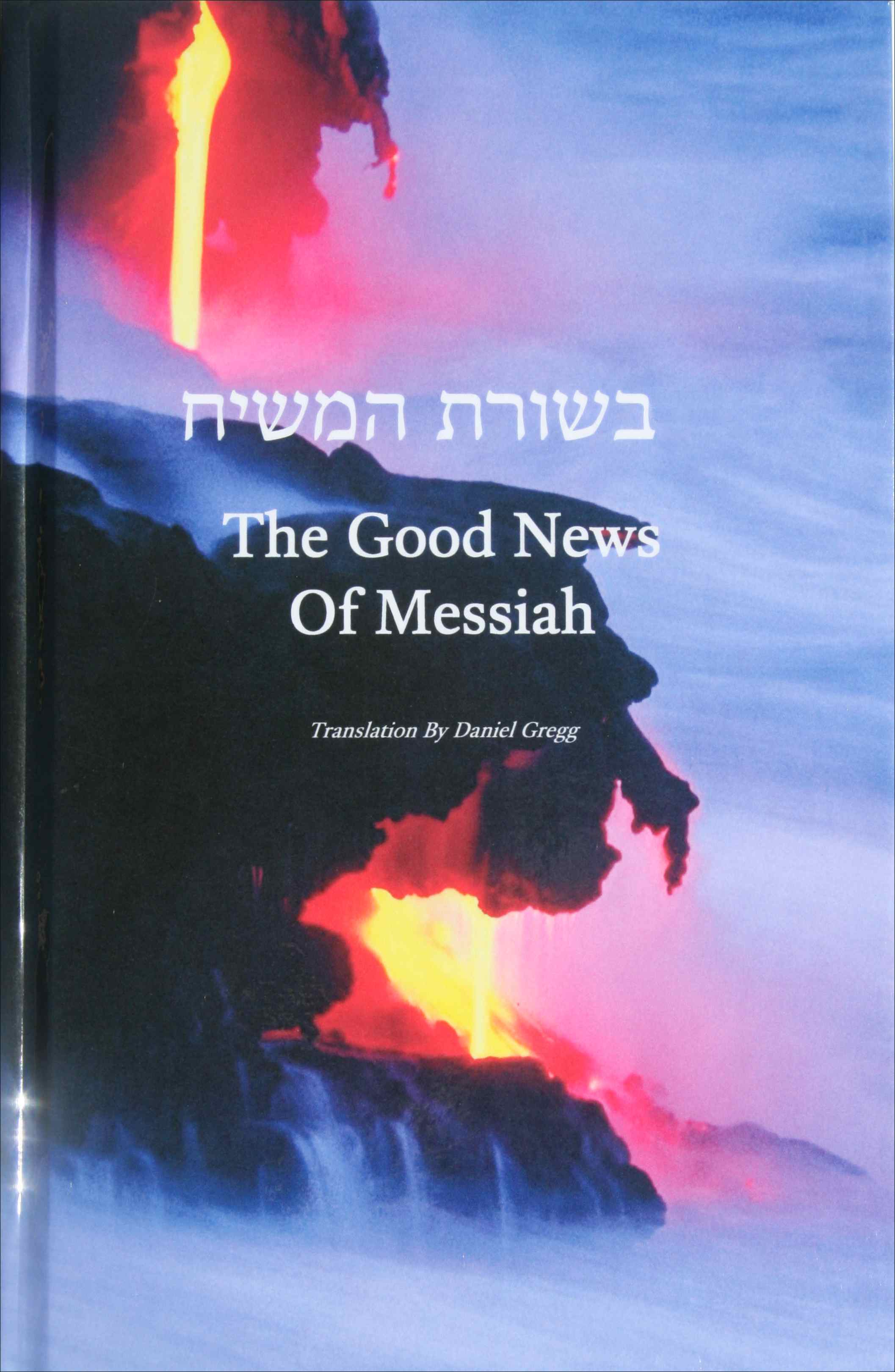
Also, if you go to the order page and click on the picture of the Good News of Messiah, you can preview it.

Also, if you go to the order page and click on the picture of the Good News of Messiah, you can preview it.
בשורת המשיח Home Page
The Good News Of Mĕssiah is a
fresh Messianic rendition of the New Testament correcting errors in
traditional translations. Anti-Law (or anti-Torah) passages are
corrected using definitions only found in standard Lexicons. As a
translator I do not make up any words, or paraphrase, but I use well
documented meanings. Here is the link
to some key definitions. If something is an interpretation, the words
are in italics. However, unlike the NASB, I am deleting many of the
trivial italics, as these are just a nuisance. Many other deep
theological problems of the Church are also corrected to comply with
Torah. However, the translation is not meant to teach Jewish Tradition,
but rather to agree with the Torah and Prophets in plain English, and
to use only important Hebrew words sparingly. Except for sacred names,
names remain in their usual English format with parsimonious
exceptions. The translation is literal except where literalness is
unintelligible or where literalness and connotation separate in the
target language from the source language.
For example, πιστις
(pistis) is consistently rendered faithfulness according
to def. #1 in the standard lexicon. Also the verb πιστευω
is rendered with a Hebrew cast, "to fix your support" on Mĕ̃ssiah Yĕ̃shua,
instead of "believe." Making your support on Yĕshua
implies trust and loyal support. This corrects the modern notion
that it is only necessary to believe
and that repentance does not matter. The third edition now renders the
verb as ‘be trustingly faithful.’ The Hebrew idea of giving
support to Yĕshua, or making one's support on him is explained in the
footnotes and sometimes used in the translation.
Where Mĕssiah's name appears, it is rendered Yĕ̃shua (with no disrespect to the pronunciation Jĕsus). Yĕ̃shua is simply more accurate. The original Manuscripts marked the sacred names and titles to indicate Hebrew be used in place of Greek, or any other language, and also to indicate the divinity of the bearer. These markings are indicated by the up raised arms over the vowel /ĕ/in the Good News of M ĕ̃̃ssiah, and also mean that the Sŏ̃n of the Alm̃ĭghty is Yẵhweh manifest.
When it is clear that the sacred name is used in a quoted text from the Torah and Prophets, the text renders Yẵhweh.
This translation translates the Greek word νομος correctly as a norm in texts where Paul has traditionally been thought to be teaching against Torah (the Law). This also is according to definition #1 in the standard lexicon.
Also the text correctly translates δικαιοσυνη as justice in many places instead of righteousness. These corrections are supported by the best scholarly sources documented here, which any reader can see make more sense in contexts like Rom. 10:4, “Mĕ̃̃ssiah is the end of the norm for justice ...” or Gal. 2:21, “For if justice comes through the norm, then Mĕ̃̃ssiah died needlessly.”
By correcting these
problems, The Good News Of Mĕssiah restores the message to its
pure form before lawlessness crept in. Yĕshua is the end of the norm for
justice. The norm for justice says that the sinner must die for their own sin.
Yĕshua, however, is the exception to the norm. He paid the penalty for our sins
so that we do not have to suffer the norm of justice. As the covenant maker, He
alone walked through the pieces while Abraham slept, signifying that He would
pay the penalty when Israel violated His covenant. Now the penalty is paid, and
the covenant is renewed. That is the good news. Here is a link to a comparison chart with other versions.